Latest News (August 2023)
In mid-2022 BroadLights developed a concept called “CityLink” to provide extended connectivity ranges in crisis zones by sharing a single backbone device (e.g. a StarLink terminal) with up to 30 different locations by using license-free WiFi frequencies, therefore allowing a very quick deployment without any red tape involved other than customs to get the equipment into the country.
So far we have deployed multiple CityLink units as follows:
- A demo unit in a major city to further promote the concept to the local authorities and potential partners (StarLink backbone).
- A comprehensive field trial which ran for several months in 2022, resulting in significant data collection and definition of several best practices (StarLink backbone).
- A stress test scenario indicating how far the system could effectively operate in the field with harsh circumstances, eventually reaching distances of up to 20kms with satisfactory results (StarLink backbone).
- Finally, a full scale production (nonprofit) deployment currently operational in a mid size city with the main CityLink antenna installed high up in a TV tower therefore with great line of sight options, providing wireless broadband to a small village 15kms away which before only had erratic connectivity via 4G towers (Fiber backbone).
During the rest of 2023 we are collecting data from the production deployment above and looking into expanding the concept to other regions, such as remote islands in the Caribbean, Pacific and Indian Oceans as well as temporary expedition site setups such as at base camps in the Himalaya region to improve their safety and reduce reliance on satellite communications where feasible.
We used equipment from AirSpan’s Mimosa (mimosa.co/products) and appreciate the support they showed during the at times challenging development of this nonprofit project.
Please feel free to reach out if you would like to learn more about the CityLink initiative.
What is BroadLights?
In developed countries most of us have easy access to connectivity that is more than adequate for basic usage such as web browsing and email, becoming easily frustrated at times when we cannot quickly get online because nowadays we consider this as being the norm.
Now imagine having sufficient technology literacy to use a smartphone that you own (or at least have access to) and not having the financial means to pay for data plans in the location where you live. This is a reality in many countries in the world, mostly at poorer communities in relatively wealthy countries (such as indigenous tribes worldwide or refugee camps in host countries) and above all in some of the poorest member states of the United Nations.
The image below facilitates the comprehension of the enormous Digital Divide challenge ahead of us:
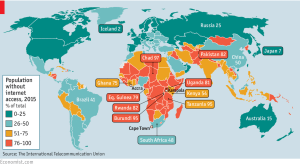
The Digital Divide Challenge
There are up to 4 billion people today who are still not connected to the internet – more than half of mankind’s 7.5 billion souls. As a frequent internet user, you are certainly aware that the lack of affordable online access would make many of your current activities much harder and perhaps impossible.
In the poorest communities in the world the same holds true, but with many added complications – as citizens who live in often isolated and vulnerable communities without connectivity are also prevented from:
- Checking the latest market prices for the products they make and services they offer
- Accepting electronic payments instead of relying only on riskier cash transactions
- Having access to continuous online education and personal development opportunities
- Accessing doctors online to diagnose concerns which are beyond the knowledge of local health professionals
- Applying for remote work possibilities which can help reduce global inequalities; simple tasks hard to automate which can be done in a mobile with little training – such as Data Entry, Software Q&A, training Artificial Intelligence engines (what does a tree look like?) and many many more.
- Learning how to best protect their environment’s core resources as effectively as possible considering their severe economical constraints (land, water, air)
- The list is long and goes on, but the solution is very simple: making affordable connectivity available in the communities where none yet exists so that they can join the rest of us online
This leads us to conclude that it is in some of the communities where affordable connectivity could bring the greatest benefits and highest returns on investment that it is the least available nowadays due to lack of profitable business models attracting private investment capital.
With Mohammad Yunus, who was speaking at the Gates Foundation Gatekeepers event in New York
www.facebook.com/526445810/posts/10154776768090811
The meaning of the name BroadLights
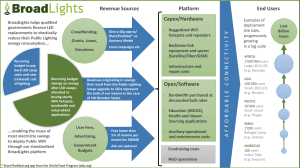
One of the several manners through which wireless connectivity can be made more affordable in the countries which need it the most is by raising subsidies from several sources (grants, donations, etc) – but we believe that first and foremost to be truly sustainable and scalable worldwide this should be done by saving costs from existing recurring public budgets through the implementation of more efficient technologies widely available today.
The prime example of such cross-fertilisation is the replacement of public lighting lamps in those locations (usually sodium, fluorescent or incandescent) by the much more efficient LED equivalents. In many of the poorest and most isolated countries in the world diesel and coal are burned because no cheaper alternatives are available and most of it is wasted in the case of lighting because LEDs are around 80% more efficient than incandescent bulbs and 50% more then fluorescent bulbs.
This is an absurd situation, where ship (or truck) fuel is burned to take diesel all the way to a poor community… to be burned – wasting up to 80% of its output in the case of incandescent public lighting infrastructures that can represent around 15% of a governments electricity budget on average.
The main reason why this legacy infrastructure is unlikely to be replaced soon as is currently being done in most of the developed world is that those vulnerable countries cannot raise financing to go ahead with such large scale projects, either due to their small size and remote locations make it difficult to establish a profitable project for LED vendors or because they have very poor (or no) credit ratings to justify the leasing arrangements typical of such technological upgrades.
BroadLights focuses therefore on federating and aggregating several small players into a significant group of countries with the critical mass necessary to raise the adequate finance and swap the legacy infrastructure with LED lamps – burning lower fossil fuel amounts and freeing up existing governmental budgets to re-invest in public wifi hotspots and pay for the recurring bandwidth and maintenance costs.
Therefore BroadLights is meant to signify “Affordable wireless broadband made possible by the deployment of LED Lights”
With Alexander Betts from the Oxford University Refugee Studies Centre at Concordia.net during the UN General Assembly week
www.facebook.com/526445810/posts/10153798971285811
UN-OHRLLS Countries
United Nations Office of the High Representative for the Least Developed Countries, Landlocked Developing Countries and the Small Island Developing States
The UN has grouped a particularly vulnerable member states within the OHRLLS agency, which include Least Developed Countries (LDCs), Landlocked Developing Countries (LLDCs) and Small Island Developing States (SIDSs) – where 1.1 billion people live across 92 nations.
These are the poorest of the poor, representing almost half of the United Nations and requiring particular attention to their highly specific problems. They tend to suffer of acute Digital Divide far more than the “rich half” of the UN because:
- Other developmental priorities such as shelter and food for their native populations must take priority when compared to affordable internet access (context of LDCs)
- They’re far from submarine cable landing points, making it exceedingly expensive to bring backbone fibre links to their locations (context of LLDCs)
- They’re isolated small communities with intermittent and expensive transportation schedules, sometimes also highly fragmented and very challenging to serve in a profitable manner (context of SIDS, especially in the case of widespread archipelagos)
BroadLights aims to bring affordable connectivity to those countries by working closely with local governments at national, regional and municipal levels to find adequate financing sources and allowing their most economically vulnerable communities to access affordable wireless internet.
With the former president of Kiribati Anote Tong at the Smart Island Congress
www.facebook.com/526445810/posts/10154369289045811
Refugee Connectivity
More than 65 million people are living today as Refugees or as Internally Displaced Persons (IDPs), almost 1% of the world’s population and the largest number since the Second World War.
BroadLights focuses on pragmatic solutions to deploy affordable connectivity in areas with high concentrations of Refugees/IDPs to help bring back their dignity via educational and remote micro-work opportunities.
www.unhcr.org/connectivity-for-refugees.html
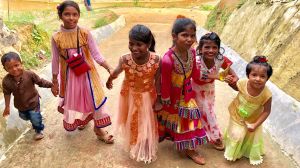
BroadLights visited the Rohynga Refugee camp near the border between Bangladesh and Myanmar in Sep’18, read more about that experience via the links below:
www.facebook.com/526445810/posts/10155545246720811
www.facebook.com/526445810/posts/10155546187490811
www.facebook.com/526445810/posts/10155546190290811
Indigenous Tribes Connectivity
150 million tribal people live in more than 60 countries across the world. Many native communities worldwide live too far from urban centres to make it economically viable for traditional operators to get affordable connectivity to their areas as the typical GSM tower equipment is expensive both to install and to maintain.
BroadLights empowers those communities with access to technologies adapted to remote areas such as increasingly affordable Satellite Broadband via our multiple global partners in that sector.
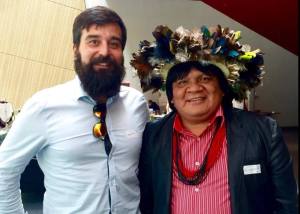
Meeting one of the most remarkable indigenous leaders in the world, Chief Almir Suruí from Rondonia, Brazil at the Swisstainability Forum in Lausanne
www.facebook.com/526445810/posts/10153858533945811
Supporting other NGOs
There is a tremendous number of Non Governmental Organisations doing amazing work worldwide and for them having adequate levels of connectivity is increasingly becoming a key element to make their project a success.
BroadLights is delighted to help them get the connectivity they need by supporting their fundraising with a common platform, negotiating the best possible deals with vendors and helping manage the networks once they have been installed.
If you work for an NGO and need connectivity to make your project successful, please send an email with a concept note to info@broadlights.org for us to assess if we are in a position to help your initiative.
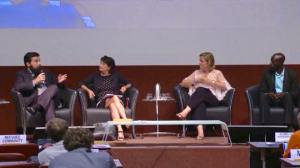
BroadLights founder Marcelo Garcia announcing the Innovation Awards with Kelly Clements (UNHCR Deputy High Commissioner), Imogen Foulkes (BBC Switzerland) and Peter Batali, a Southern Sudanese Refugee innovator. More details below:
www.facebook.com/526445810/posts/10155401063720811
www.unhcr.org/innovation/innovation-awards
Affordable Wireless Technology
BroadLights is technology agnostic in the sense that we focus on solving the “Last 100 Meter Problem” in the most cost efficient way depending on the local situation at the deployment site. We believe that for the most flexible and cost effective outcomes, in the vast majority of cases this means providing good quality WiFi connections to our end users because with billion of chipsets already in operation worldwide and billions more to be produced before 2020, this is by far the most pervasive standard for wireless connectivity in the foreseen future.
For the backbone connectivity, as we work often with concepts that involve remote location, the use of Broadband Satellite is oftentimes the only alternative to bring affordable internet to the target audience. In other scenarios – such as in urban destitute communities – the use of GSM technologies and even fibre if available would be preferred due to the lower cost per gigabyte that those alternatives provide.
We are also big fans of the latest technologies still fresh out of the lab such as Outdoor LiFi and very keen to hear from innovators working in the Digital Divide domain. If that’s your case, please send us a message to info@broadlights.org with a product spec sheet and we’ll be glad to book a call to deep dive on how to work together in the future if there’s a match.
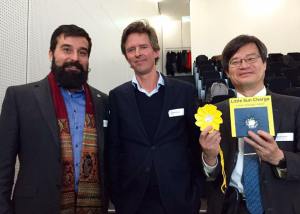
Meeting the Nobel Prize winner inventor of the white LED technology Hiroshi Amano and the founder of LittleSun.com Frederik Ottesen at the “Light for Life” CSEM.ch conference
www.facebook.com/526445810/posts/10153473404065811
Service Pricing Approach
What is free is unfortunately sometimes perceived as having no value, so BroadLights does not favour offering free wireless access to the internet in the vulnerable communities it serves. It does however believe in using the United Nations benchmark of internet pricing as being below 5% of the monthly revenue in the location where it is being delivered. If that means just a couple of cents a month, so be it – to be able to afford those deployments in such cases, we will strive to collect donations via traditional grant writing and more recent crowd-funding approaches worldwide via our wide network of partners and friends.

With Princess Nisreen El Hashemite, a strong supporter of Science and Technology for Development at UNCTAD’s CSTD conference in Geneva
www.facebook.com/526445810/posts/10154412070825811
Net Neutrality and the Rule of Law
One of the most discussed topics in the Internet Governance world is whether governments should support full Net Neutrality vs. alternatives such as “walled gardens” real or virtually imposed by policies such as providing zero rating to sites which help subvention the connectivity. We strive to provide full access to the whole of the internet to our users, with one caveat – it has to be clearly legal where we operate.
BroadLights will always strive to comply with laws and customs of the country where we are deploying our solutions and work in harmonious partnership with local communities and law enforcement to focus on how to bring the highest possible return on investment by generating significant additional economic output in the communities we serve.
www.eff.org/issues/net-neutrality
© 2015-25 Marcelo Garcia – All Rights Reserved


 Wisdom Foundation Initiatives: ExplorersWeekend.org, WisdomAccelerator.org, BroadLights.org